
Commend mundial

Seleccione región

  • Commend Austria & CEEAustria y Europa Central y Oriental
  • English
  • Commend AdriaCroacia, Bosnia-Herzegovina, Serbia
  • English
  • Commend SlovakiaEslovaquia, Chequia
  • English
  • Commend NordicDinamarca, Finlandia, Islandia, Noruega, Suecia
  • English
  • Commend NordicDinamarca, Finlandia, Islandia, Noruega, Suecia
  • English
  • Commend HungarySu socio local para Hungría
  • Hungarian
  • Commend NordicsDinamarca, Finlandia, Islandia, Noruega, Suecia
  • English
  • Commend NordicDinamarca, Finlandia, Islandia, Noruega, Suecia
  • English
  • C&C PartnersPolonia, Estonia, Letonia, Lituania
  • English
  • Commend IbèricaEspaña, Portugal
  • Spanish
  • Commend Austria & CEEAustria y Europa Central y Oriental
  • English
  • Commend SlovakiaEslovaquia, Chequia
  • English
  • Commend Austria & CEEAustria y Europa Central y Oriental
  • English
  • Commend IbèricaEspaña, Portugal
  • Spanish
  • Commend NordicDinamarca, Finlandia, Islandia, Noruega, Suecia
  • English
  • EFB Elektronik TürkiyeTurquía
  • English
  • Commend Austria & CEEAustria y Europa Central y Oriental
  • English
  • Oriente MedioEAU, Levante, CCG
  • English
  • Oriente MedioArabia Saudí, Levante, EAU
  • English
  • Oriente MedioEAU, Levante, CCG
  • English
  • Commend InternationalGlobal Website
  • English
  • Commend InternationalSudáfrica
  • English
  • TKHSAAIndonesia, Malasia, Filipinas, Singapur, Corea del Sur, Taiwán, Tailandia
  • English
  • Commend AustraliaAustralia, Nueva Zelanda
  • English
  • Commend Middle AsiaKazajstán, Kirguistán, Tayikistán, Turkmenistán y Uzbekistán
  • Russian
  • Commend AustraliaAustralia, Nueva Zelanda
  • English
  • TKHSAAIndonesia, Malasia, Filipinas, Singapur, Corea del Sur, Taiwán, Tailandia
  • English
  • TKHSAAIndonesia, Malasia, Filipinas, Singapur, Corea del Sur, Taiwán, Tailandia
  • English
  • TKHSAAIndonesia, Malasia, Filipinas, Singapur, Corea del Sur, Taiwán, Tailandia
  • English
  • Commend Middle AsiaKazajstán, Kirguistán, Tayikistán, Turkmenistán y Uzbekistán
  • English
  • Commend Middle AsiaKazajstán, Kirguistán, Tayikistán, Turkmenistán y Uzbekistán
  • English

Protecting Public Spaces Under Martyn's Law

The Terrorism (Protection of Premises) Act 2025, often referred to as Martyn’s Law, places new legal obligations on UK venues and events to improve terrorism preparedness and protect the public. The law was granted Royal Assent in April 2025 and a 24 month implementation period will allow organisations to make necessary changes. Premises with a capacity of 200–799 people (standard tier) must notify the regulator and implement public protection procedures addressing evacuation, invacuation, lockdown and communication. 

Enhanced tier venues (800+ capacity) must also introduce measures to reduce their vulnerability, such as searches or CCTV. Guidance emphasises that plans must be communicated to staff and visitors and be practised through training and drills.

Martyn’s Law represents a paradigm shift in how public and private venues in the UK must prepare for and respond to terrorism. The law places a strong emphasis on communication, training and preparedness. By adopting integrated intercoms, interactive kiosks, PAVA systems, unified mass notification platforms, AI-powered translation and real-time audiovisual analytics, organisations can meet these obligations. These technologies not only enhance situational awareness and decision making during a crisis but also improve day to day operations and customer experience.

The combination of proactive detection and coordinated, multichannel communication is key. AI analytics detect threats before they cause harm, while unified audiovisual systems ensure that every individual, regardless of language or ability, receives accurate instructions. Implementing such a strategy will help venues comply with Martyn’s Law, protect their staff and visitors, and create safer, more resilient spaces.
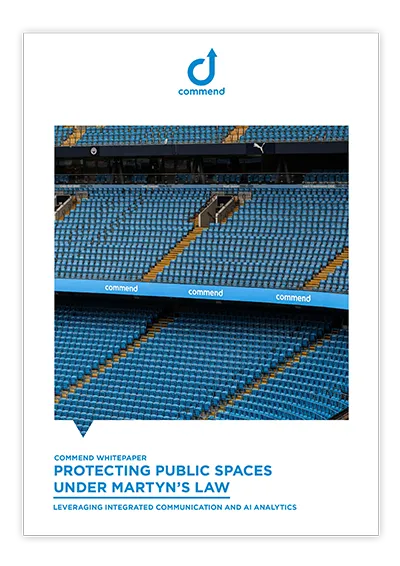
Download Whitepaper

Explore how organisations can meet Martyn’s Law obligations by adopting integrated audio–visual communication systems, AI-powered voice assistants and real time video analytics. Each technology supports clear, controlled communication in both day to day operations and crisis situations and, when combined, delivers a powerful protective strategy.